
When Texas rain arrives hard and fast, gutters have to move a large volume of roof runoff in a short period. A gutter that looks adequate during light rain can overflow during a strong thunderstorm if the system is undersized, poorly pitched, clogged or paired with insufficient downspouts.
That is why choosing gutter size should be based on the home’s actual drainage requirements rather than appearance alone. National Install provides gutter installation in Fort Worth and surrounding DFW communities. This guide explains the factors professionals consider when selecting gutter capacity for a Texas home.
What Are the Most Common Residential Gutter Sizes?
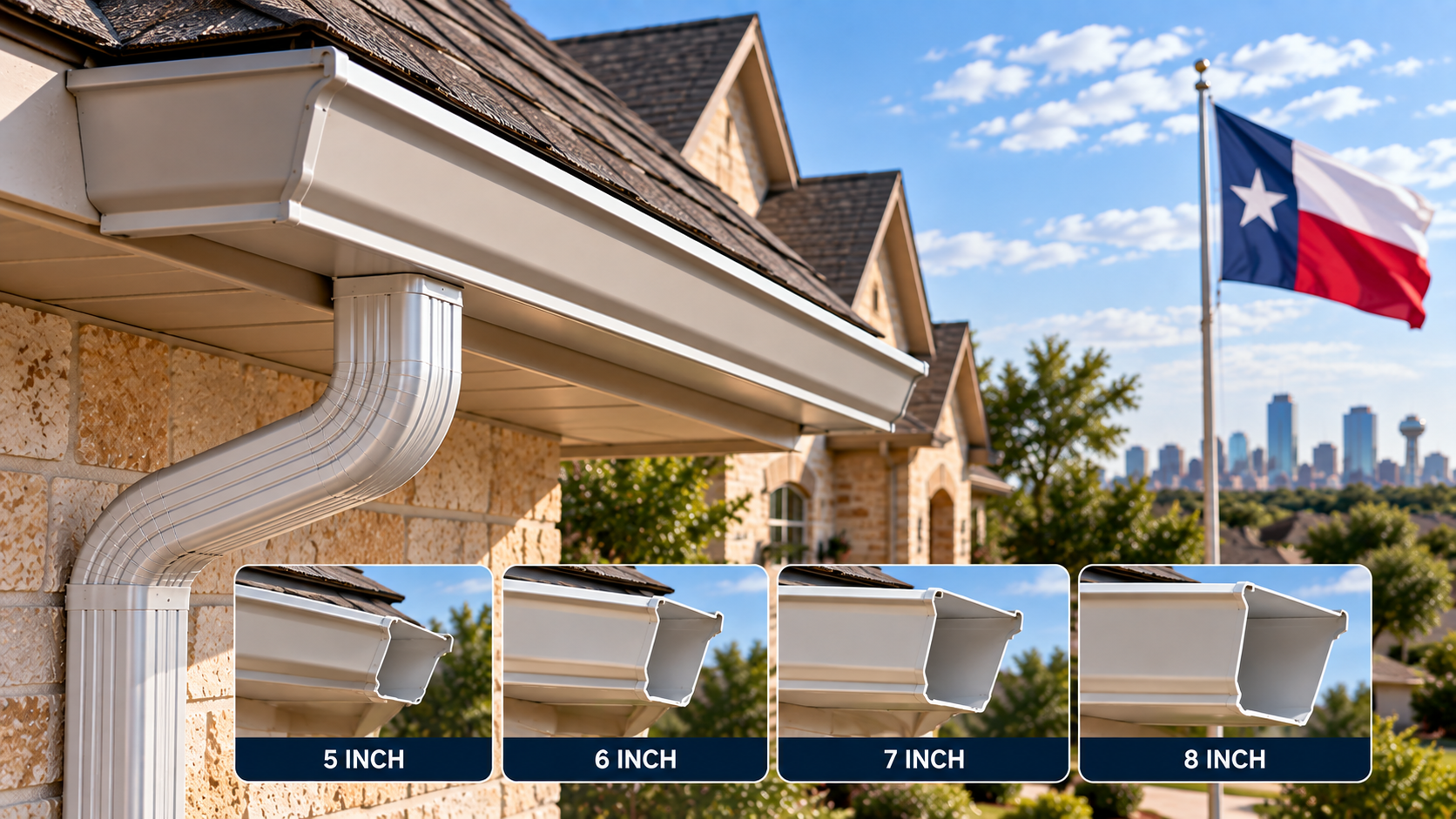
For many residential applications, 5-inch and 6-inch K-style gutters are common choices. Larger profiles are available for properties with greater drainage demands, but bigger is not automatically better.
| Gutter Size | Typical Residential Context | Important Considerations |
|---|---|---|
| 5-inch | Common on many standard residential rooflines | Capacity must still match roof area, pitch, rainfall and downspouts |
| 6-inch | Often considered for larger or steeper drainage areas and heavier runoff | Requires compatible outlets, downspouts, hangers and roof-edge conditions |
| Larger profiles | Specialized residential or commercial drainage situations | Should be selected through project-specific drainage evaluation |
Why Texas Homes Need Properly Sized Gutters
North Texas weather can produce periods of intense rainfall. During those events, thousands of gallons of water may move across a roof over the course of a storm. The gutter system must collect that runoff without allowing unnecessary overflow and then move it through outlets and downspouts efficiently.
When the system cannot keep up, water can spill over the front or back of the gutter, splash against exterior walls, wash out landscaping and concentrate moisture near the perimeter of the home.
Correct sizing is therefore part of a broader water-management strategy. It works together with downspout placement, grading and appropriate discharge locations.
Factor 1: How Much Roof Area Drains Into the Gutter?
The first major consideration is the roof drainage area feeding a particular gutter run. A gutter does not necessarily serve the entire roof. Each roof plane directs water toward specific eaves, valleys and collection points.
A long eave receiving runoff from a large roof plane has a greater drainage demand than a short section beneath a small porch roof. Complex homes may have several drainage zones that need to be evaluated independently.
Valleys can also concentrate runoff. Where two roof planes direct water toward the same location, a large amount of water can enter a relatively short section of gutter.
Factor 2: Roof Pitch Changes Runoff Behavior
Roof pitch is another important variable. Steeper roofs can move water toward the eaves quickly, while lower-slope roofs may behave differently. Sizing methods commonly account for roof pitch when estimating the effective drainage area.
This does not mean every steep roof automatically needs oversized gutters. It means pitch should be considered together with roof area, rainfall intensity and the capacity of the complete drainage system.
Factor 3: Texas Rainfall Intensity
Gutter design is not based only on annual rainfall totals. The intensity of rainfall over a short period matters because the system has to handle the flow arriving at that moment.
Fort Worth and DFW homeowners are familiar with thunderstorms that can shift from light rain to heavy downpour quickly. A properly designed gutter system should account for local rainfall conditions rather than being sized solely by what is common in another region.
Factor 4: Downspout Size and Quantity
Downspouts are one of the most overlooked parts of gutter sizing. The gutter is only a collection channel. Water still has to leave through an outlet and travel down the downspout.
If the gutter can collect more water than the outlets and downspouts can discharge, the system can back up and overflow. Larger gutters are therefore often paired with larger or additional downspouts when drainage calculations justify them.
Long Gutter Runs
Long runs may require more than one outlet depending on the drainage load and layout. Dividing flow between downspouts can improve discharge capacity.
Large Roof Planes
A large roof area feeding one eave can require more capacity than a smaller roof even if both homes use the same gutter profile.
Roof Valleys
Valleys can send concentrated runoff into a small area. Splash control and local gutter capacity may require special attention.
Discharge Location
Downspouts need somewhere appropriate to send the water. Capacity is only useful if runoff is directed away from the home effectively.
5-Inch vs. 6-Inch Gutters: What’s the Difference?
A 6-inch gutter has a larger cross-sectional capacity than a comparable 5-inch profile and can accept larger outlets. This can make it useful for homes with greater drainage demands.
However, moving from 5-inch to 6-inch should be a design decision rather than a universal upgrade. A correctly sized 5-inch system with well-placed downspouts may outperform a poorly designed 6-inch system with inadequate outlets or bad slope.
The larger profile also affects appearance, material use, components and project cost. For pricing factors, read How Much Does Gutter Installation Cost in Fort Worth?.
Not Sure Which Gutter Size Your Fort Worth Home Needs?
National Install can evaluate the roofline, drainage areas and downspout requirements and recommend a gutter system based on the property rather than a one-size-fits-all rule.
Does a Bigger Gutter Always Prevent Overflow?
No. Overflow can happen for many reasons besides gutter width. Debris can block the channel or outlet. Gutters can be pitched incorrectly. Downspouts may be too few, too small or obstructed. A roof valley may concentrate more water than a local section can accept.
Increasing gutter size without identifying the cause of overflow may not solve the underlying problem. The complete drainage path should be evaluated from the roof surface to the point where the downspout discharges.
How Gutter Shape Affects Capacity
Gutter profile affects how much water a system can hold and how it integrates with the roof edge. K-style gutters are common on residential properties, while half-round and other profiles may be chosen for architectural reasons.
Two gutters described by a nominal width are not necessarily identical in cross-sectional area or performance. When comparing proposals, ask what profile and size are actually being installed rather than relying on a single dimension.
Seamless vs. Sectional Gutters and Sizing
Whether a gutter is seamless or sectional does not by itself determine the correct size. Both types still need adequate capacity, slope and downspouts.
Seamless gutters are fabricated in long custom runs, reducing intermediate joints along straight roof edges. For more information, see Seamless Gutters vs. Regular Gutters: What’s the Difference?.
How Roof Valleys Can Overwhelm Gutters
Roof valleys collect water from two adjoining roof planes and direct it toward a concentrated point. During intense rain, that concentrated stream can overshoot or overwhelm a gutter even when the rest of the system appears adequate.
Depending on the roof geometry, the solution may involve appropriate gutter capacity, outlet placement or other professionally designed water-control details. Simply adding a large splash accessory without considering the overall flow is not always the complete answer.
Do Gutter Guards Change the Size You Need?
Gutter guards are intended primarily to limit certain types of debris entering the gutter. They do not eliminate the need to size the underlying gutter and downspouts correctly.
Because guard designs interact with water differently, especially during heavy rain, homeowners should consider the complete system when adding protection. Learn more in Do Gutter Guards Really Work? Pros, Cons and Costs.
What Happens If Gutters Are Too Small?
An undersized or otherwise inadequate system may overflow during heavy rain. Repeated overflow can lead to visible staining, landscape erosion, splashback and concentrated moisture around the home.
Overflow does not prove that the gutter profile itself is too small, however. Clogs, poor pitch, limited downspout capacity and installation problems can create the same symptom. Diagnosis should come before replacement.
Can Gutters Be Too Large?
Installing a larger profile than necessary is not usually a performance problem when the system is properly supported and integrated, but it may add material cost and create a bulkier appearance. Larger gutters can also require compatible hangers, outlets and downspouts.
The goal is not to install the biggest gutter available. It is to provide sufficient capacity with a system that fits the home’s roof edge, drainage requirements and architecture.
Why Downspout Discharge Matters
Once runoff reaches the bottom of the downspout, it still has to be managed. Dumping a large volume of roof water immediately beside the foundation can create perimeter moisture concerns even if the gutters themselves work perfectly.
Extensions, splash blocks, grading or other drainage solutions may be appropriate depending on the property. Gutters are one component of overall site water management.
For additional context, read Why Gutters Are Important for Protecting Your Home’s Foundation.
Signs Your Current Gutter System May Need Evaluation
- Water regularly spills over during heavy rain.
- Overflow occurs near roof valleys or long gutter runs.
- Downspouts appear unable to keep up with incoming water.
- Water remains standing in gutters after rain.
- Gutters sag, pull away or have recurring alignment problems.
- Landscape erosion appears below roof edges or downspouts.
- Water discharges immediately beside the home’s perimeter.
How a Professional Determines the Right Gutter Size
A professional evaluation starts with the roof rather than the gutter catalog. The installer considers the roof areas feeding each eave, roof pitch, concentrated drainage points, gutter-run lengths, local rainfall conditions and possible outlet locations.
From there, gutter profile and downspout capacity can be selected as a system. Existing fascia conditions, roof-edge details and the desired discharge locations also affect the installation plan.
This property-specific approach is more reliable than assuming every Texas home needs the same nominal gutter width.
Frequently Asked Questions
Are 5-inch gutters big enough for a Texas home?
They can be for many homes, but adequacy depends on roof drainage area, pitch, rainfall intensity, gutter profile, outlets and downspouts. The system should be sized for the specific property.
When should I consider 6-inch gutters?
Six-inch gutters may be considered when roof drainage areas are larger, rooflines are steep or complex, runoff is concentrated, or additional capacity is otherwise justified by the system design.
Do 6-inch gutters need larger downspouts?
Larger gutters are often paired with larger-capacity outlets or downspouts when needed. The appropriate combination depends on the amount of water the system is expected to handle.
Why do my gutters overflow even though they look large?
Overflow can result from clogged outlets, debris, inadequate downspouts, incorrect slope, concentrated valley runoff or insufficient overall capacity. Gutter width is only one possible cause.
What gutter size is best for heavy Texas rain?
There is no universal best size. The correct system is determined by roof drainage area, pitch, rainfall intensity and outlet/downspout capacity. Larger profiles may be appropriate for higher-demand roof sections.
Choosing the Right Gutters for Your Fort Worth Home
The right gutter size is the one that can manage the water delivered by your specific roof and move it through properly sized outlets and downspouts. For some homes that may be a well-designed 5-inch system. Others may benefit from 6-inch or another appropriately engineered configuration.
National Install provides gutter solutions in Fort Worth and surrounding DFW service areas. If your existing gutters overflow or you are planning a new seamless system, request a free estimate for a property-specific recommendation.