
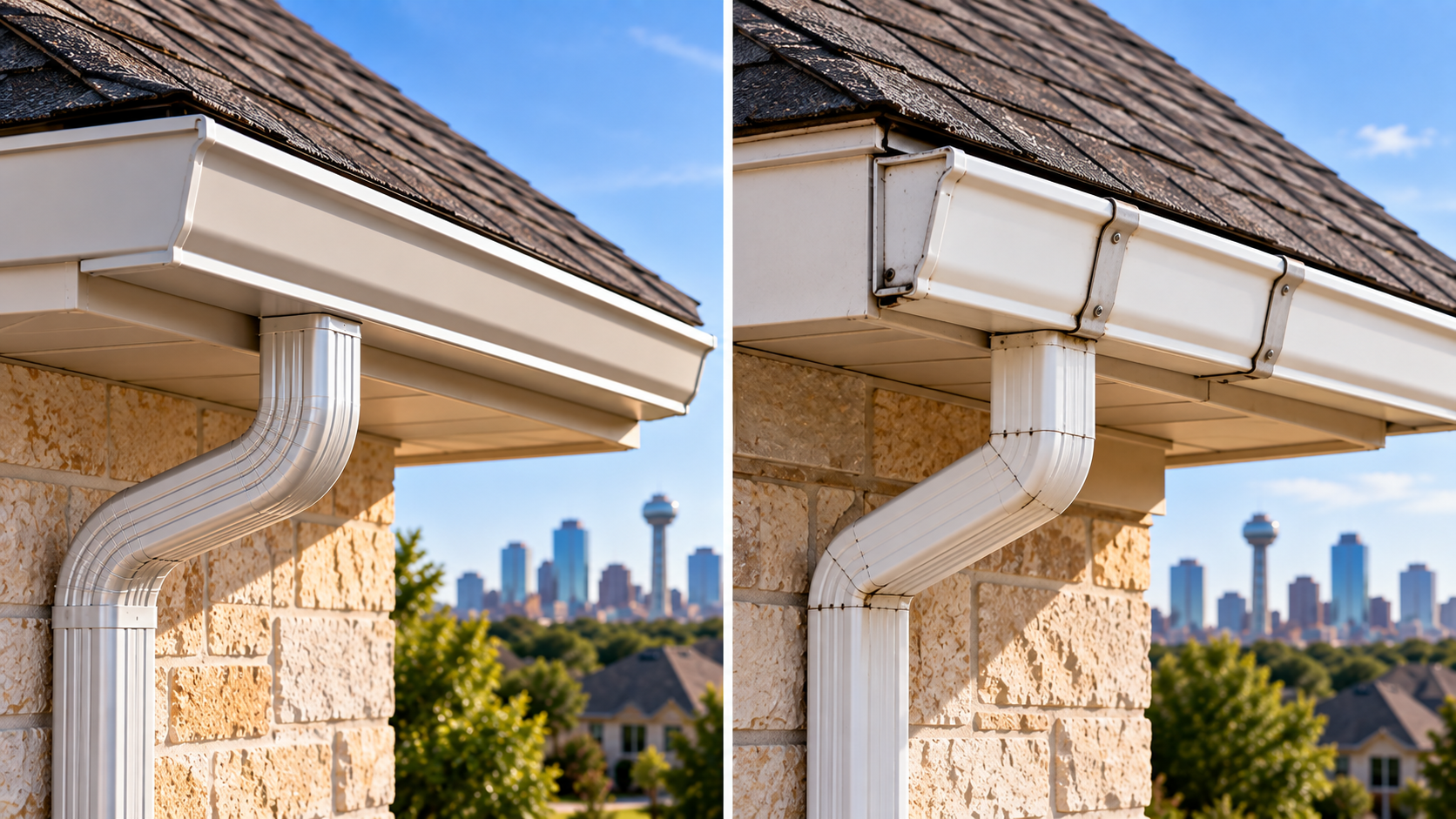
If you are replacing gutters on a Fort Worth home, you will probably encounter two terms early in the process: seamless gutters and regular gutters. At first glance they may look nearly identical. The main difference is how the gutter runs are manufactured and assembled.
That construction difference affects the number of seams, installation process, appearance, maintenance and potentially the long-term performance of the system. National Install provides gutter installation in Fort Worth and surrounding DFW communities. Here is what homeowners should know before choosing between seamless and sectional gutters.
What Are Seamless Gutters?
Seamless gutters are fabricated to match the measured lengths of a home’s roof edges. A gutter-forming machine shapes coil material into long gutter runs at or for the job site. Instead of connecting many short pieces across a straight roofline, the installer can use one continuous run wherever the architecture allows.
The word “seamless” does not mean the entire drainage system contains absolutely no joints. Corners, end caps, outlets and certain transitions still require connections. The key advantage is that long straight sections generally do not need intermediate joints every few feet.
What Are Regular or Sectional Gutters?
Regular gutters, commonly called sectional gutters, are manufactured in predetermined lengths. Installers or homeowners join the sections together to span the required roof edge.
Sectional systems can be practical because the individual pieces are easy to transport, purchase and handle. They are common in home-improvement retail settings and DIY projects. The tradeoff is that a long gutter run can contain several joints that must remain sealed and aligned.
Seamless Gutters vs. Regular Gutters: Side-by-Side
| Feature | Seamless Gutters | Regular / Sectional Gutters |
|---|---|---|
| Construction | Long custom-fabricated runs | Multiple predetermined sections joined together |
| Joints | Primarily at corners, outlets and necessary transitions | Additional joints along straight runs |
| Appearance | Clean, continuous roofline | Visible connection points may occur |
| Installation | Typically professionally measured and fabricated | Can be professionally installed or DIY |
| Repair | Long runs may require specialized fabrication or repair | Individual sections can sometimes be replaced |
| Maintenance | Fewer intermediate joints to monitor | More joints and seals may need attention |
| Customization | Made to the home’s measured roofline | Assembled from standard-length components |
Do Seamless Gutters Leak Less?
Seamless gutters reduce the number of intermediate joints along straight runs, which means there are fewer connection points where sealant can deteriorate, sections can shift or small gaps can develop. That is one of their primary practical advantages.
However, no gutter system is leak-proof. Seamless gutters still have corners, end caps and outlets, and those areas need correct fabrication and installation. Water can also overflow because of debris, inadequate sizing, poor slope or insufficient downspout capacity even when the gutter itself has no failed seam.
Which Type Looks Better?
Many homeowners prefer seamless gutters because the long uninterrupted runs create a cleaner roofline. There are fewer visible joints, and professionally fabricated systems are made to the dimensions of the property.
Color and profile also influence appearance. Seamless aluminum systems are available in a broad range of finishes that can coordinate with fascia, trim, siding, brick and roofing.
Sectional gutters can still look attractive when installed carefully, but the connection points may become more noticeable over time if sections move or sealant ages.
Which Is Better for Fort Worth Weather?
Fort Worth gutters need to manage intense sun, wind and periods of heavy rainfall. Neither seamless nor sectional construction alone determines whether a system can handle a Texas thunderstorm. Capacity depends on gutter size, roof drainage area, roof pitch, outlets and downspouts.
A continuous gutter run can reduce unnecessary joints, but it still needs adequate drainage. A long gutter with too few or undersized downspouts can overflow during heavy rain.
For that reason, homeowners should consider the complete drainage design rather than choosing gutters based only on whether they are seamless. Our guide to gutter sizing for Texas homes explains this in more detail.
How Are Seamless Gutters Installed?
A professional seamless-gutter project typically begins with measuring the roof edges and evaluating drainage locations. The installer determines the required run lengths, corners, outlets and downspout positions.
Coil material is then formed into the selected gutter profile in continuous lengths. The runs are cut to fit the measured roofline, fitted with necessary components and attached with the appropriate slope toward the outlets.
Downspouts are then installed and routed to discharge water away from the immediate foundation area or into an appropriate drainage solution.
Considering Seamless Gutters for Your Fort Worth Home?
National Install can measure your roofline, evaluate drainage requirements and provide a project-specific gutter installation estimate for your property.
Are Seamless Gutters More Expensive?
The cost comparison depends on material, gutter size, home height, linear footage, roofline complexity, downspouts and whether you are comparing professional installation with a DIY sectional system.
Custom fabrication and professional installation can make a seamless project more expensive upfront than purchasing basic sectional components. But initial material price is only one consideration. Homeowners should also compare installation quality, number of joints, expected maintenance and the complete drainage design.
For a full breakdown of project variables, see How Much Does Gutter Installation Cost in Fort Worth?.
Which Type Is Easier to Repair?
Sectional gutters have an intuitive repair advantage: a damaged standard-length section may sometimes be removed and replaced without fabricating an entire long run. Matching older profiles, colors and components can still be a challenge.
With seamless gutters, localized repairs may be possible depending on the damage and location. More extensive damage to a continuous run can require specialized work or replacement of a larger section.
The better strategy is to reduce preventable problems through secure attachment, correct drainage and routine maintenance.
Do Seamless Gutters Require Maintenance?
Yes. “Seamless” describes the construction method, not a maintenance-free system. Leaves, roof debris, seed pods and other material can still accumulate in any open gutter. Outlets can become obstructed, and downspouts can clog.
Homeowners should periodically observe gutter flow, particularly during or after rain, and address visible debris or drainage problems safely. Gutter guards may reduce some debris entry but do not eliminate all maintenance. See Do Gutter Guards Really Work? for a balanced comparison.
What Materials Are Used for Seamless Gutters?
Aluminum is one of the most common residential seamless-gutter materials because it is lightweight, corrosion resistant and available in many factory-applied colors. Other metal options can also be fabricated or installed as gutter systems depending on the project.
Material affects cost, appearance, weight, corrosion behavior and maintenance. The best choice should fit the home’s architecture, local conditions and project budget.
What About Gutter Hangers and Slope?
Whether a gutter is seamless or sectional, it must be securely supported. Hanger spacing and attachment need to suit the system and the condition of the fascia or other attachment surface.
The gutter also needs appropriate pitch toward its outlets. Too little slope can allow water to remain in the channel, while poor alignment can create low spots. Excessive slope may be visually noticeable and is not a substitute for adequate outlet and downspout capacity.
Why Downspouts Matter More Than Many Homeowners Realize
Downspouts determine how quickly collected roof water can leave the gutter. A beautiful seamless run cannot perform properly if its outlets or downspouts cannot handle the incoming flow.
Placement also matters. Long runs and large roof drainage areas may require more than one outlet. Once water reaches the ground, it should be directed away appropriately rather than concentrated immediately beside the home.
This is part of why gutters can contribute to better perimeter water management. Read why gutters are important for protecting your home’s foundation for more context.
Which Is Better for DIY Installation?
Sectional gutters are generally more accessible for DIY installation because standard pieces can be transported in a personal vehicle and assembled at the property. Seamless systems typically require forming equipment and experience handling long gutter runs.
DIY accessibility does not automatically mean the finished system will perform correctly. Measuring, establishing slope, selecting hanger spacing, locating downspouts and safely working at roof-edge height all require care.
Which Gutter System Should You Choose?
Consider Seamless Gutters If…
You want a professionally measured system with clean continuous runs, fewer intermediate joints and a finish coordinated with your home’s exterior.
Consider Sectional Gutters If…
You prioritize readily available standard components, DIY installation or the ability to replace individual standardized sections in certain situations.
For many professionally installed residential projects, seamless gutters offer an attractive combination of custom fit and reduced seam count. But the best system is the one that is correctly sized, securely installed and designed to move water where it needs to go.
Questions to Ask Before Choosing New Gutters
- How much roof area drains into each gutter run?
- What gutter size is recommended for the home?
- How many downspouts are included and where will they discharge?
- What material and profile are being proposed?
- How will corners and outlets be fabricated and sealed?
- Is existing gutter removal included?
- Is the fascia in suitable condition for attachment?
- What maintenance will the finished system require?
- What product and workmanship warranties apply?
Frequently Asked Questions
What is the main difference between seamless and regular gutters?
Seamless gutters are fabricated in long custom runs, while regular sectional gutters are assembled from multiple shorter pieces. This gives seamless systems fewer intermediate joints along straight roof edges.
Are seamless gutters completely seamless?
No. Corners, end caps, outlets and some transitions still require joints. The term refers primarily to eliminating unnecessary seams along long straight runs.
Do seamless gutters last longer?
Service life depends on material, installation, environment and maintenance. Fewer intermediate joints can reduce potential seam-related maintenance, but seamless construction alone does not determine lifespan.
Can seamless gutters clog?
Yes. Leaves and debris can enter any open gutter and obstruct outlets or downspouts. Routine observation and cleaning remain important.
Are seamless gutters worth it for a Fort Worth home?
They can be a strong choice for homeowners who want custom-fitted runs, fewer intermediate seams and a clean appearance. Proper sizing and downspout design remain essential for North Texas rainfall.
Seamless Gutter Installation in Fort Worth
The difference between seamless gutters and regular gutters is straightforward, but choosing a complete drainage system requires more than counting seams. Gutter size, material, attachment, downspouts and discharge locations all influence performance.
National Install provides gutter solutions in Fort Worth and surrounding DFW service areas. If you are replacing an aging sectional system or planning new seamless gutters, request a free estimate for your home.