
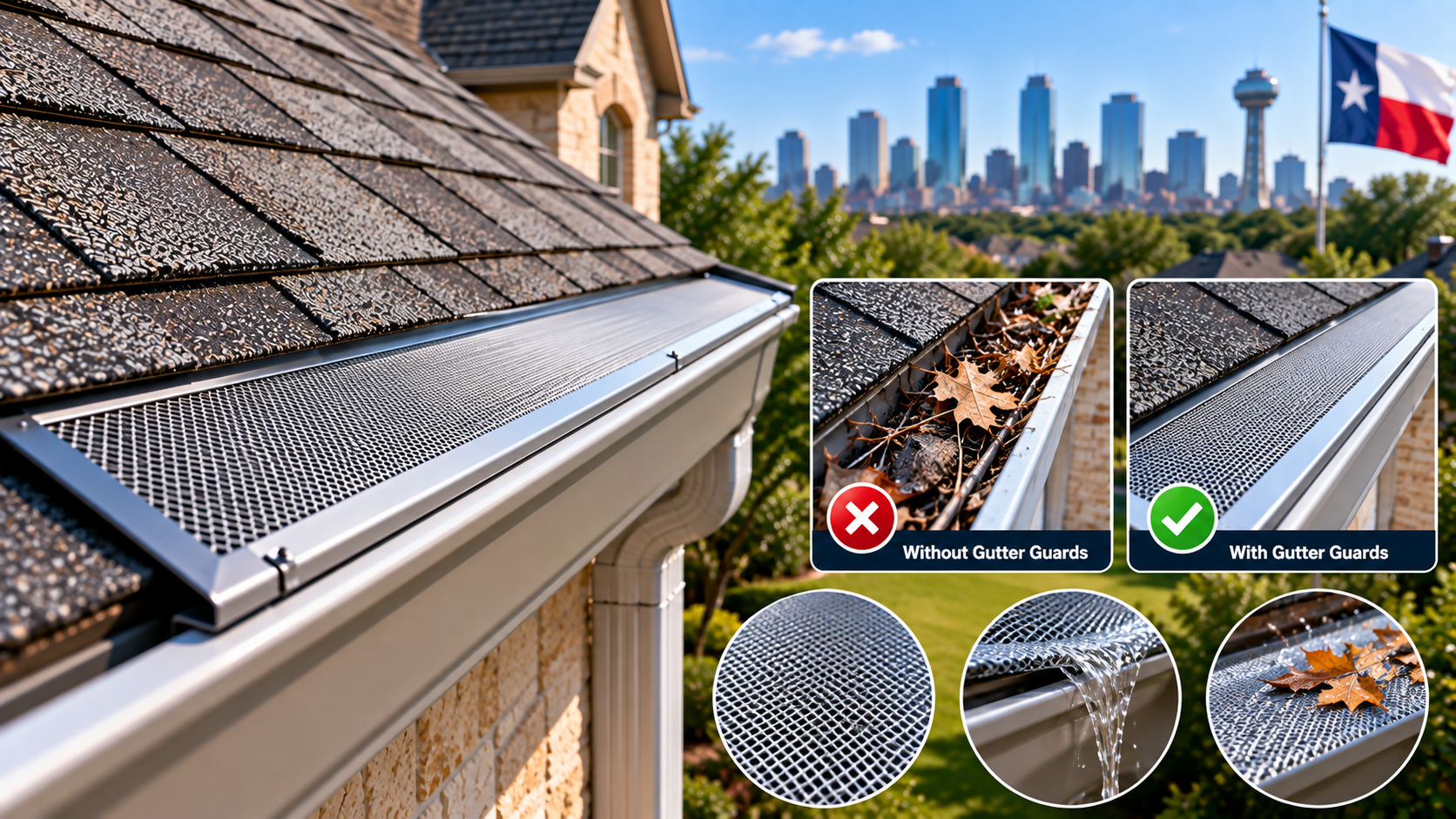
Gutter guards are often marketed as a solution to clogged gutters, but homeowners should understand what they realistically can and cannot do. A good gutter protection system may significantly reduce the amount of debris entering an open gutter. It does not eliminate the need to inspect the roof edge, remove material that collects on top of the guard, or keep outlets and downspouts functioning.
For Fort Worth and DFW homeowners, the decision also depends on nearby trees, roof design and how the gutter system performs during heavy Texas rain. National Install provides gutter installation and gutter solutions in Fort Worth. This guide explains the benefits, limitations, common guard types and cost factors to consider.
How Do Gutter Guards Work?
Gutter guards create a barrier between falling debris and the open gutter channel. Depending on the design, rain passes through small openings, mesh, slots or another water-entry surface while larger leaves and debris remain above the gutter.
The idea is simple: reduce the material that can collect inside the channel and obstruct the outlets. Different products accomplish this in different ways, and their performance can vary based on rainfall intensity, debris type, roof pitch and installation.
What Types of Gutter Guards Are Available?
Micro-Mesh Guards
Fine metal mesh is designed to allow water through while blocking many leaves, needles and smaller debris. The mesh surface itself may still need periodic cleaning.
Screen Guards
Screens use larger openings than fine micro-mesh products. They can block leaves and larger debris but may allow smaller material into the gutter.
Surface-Tension Systems
These systems are designed to guide water around a curved surface and into the gutter while allowing some debris to continue over the edge.
Foam or Insert Products
Porous inserts sit inside the gutter and attempt to keep larger debris out while letting water pass through. Their maintenance and service characteristics differ from metal systems.
What Are the Pros of Gutter Guards?
1. They Can Reduce Debris Inside the Gutter
This is the primary benefit. Leaves and twigs that would otherwise fall directly into an open gutter can be kept on top of or away from the drainage channel. Less material inside the gutter can mean fewer large debris blockages.
2. They May Reduce the Frequency of Interior Gutter Cleaning
A well-performing guard can reduce how quickly the gutter fills with debris. This may make maintenance less frequent or less intensive, particularly on homes where broad leaves are the main problem.
It is important to distinguish reduced maintenance from no maintenance. Roof grit, pollen, seeds and small organic material may still accumulate depending on the guard design.
3. They Help Keep Out Larger Objects
Twigs, leaves and other larger material can obstruct outlets and begin a chain of drainage problems. Guards can provide a useful first barrier against these objects.
4. They Can Complement a New Gutter System
When new gutters are being installed, protection can be considered as part of the overall drainage design. This allows the installer to evaluate gutter profile, guard compatibility, downspouts and roof-edge conditions together.
What Are the Cons of Gutter Guards?
1. They Are Not Maintenance-Free
Leaves can collect on top of the guard. Fine debris can settle into mesh. Valleys can deposit material in concentrated locations. The system should still be observed and cleaned when necessary.
2. Some Debris Can Still Get Through
No practical guard blocks every particle while admitting rainwater. Very small debris may enter through openings or accumulate on the guard surface.
3. Heavy Rain Can Challenge Some Designs
Water must enter the guard quickly enough during intense rainfall. Product design, roof pitch, valley runoff and installation angle can affect performance. A system that handles moderate rain may behave differently where runoff is highly concentrated.
4. They Add to the Initial Project Cost
Materials and installation increase the upfront cost compared with an open gutter. Whether that expense makes sense depends on the property’s debris exposure, homeowner priorities and selected product.
5. They Cannot Fix a Poorly Designed Drainage System
If gutters are too small, improperly pitched or paired with inadequate downspouts, adding a guard does not solve the underlying capacity problem. Start with a properly designed drainage system.
Gutter Guards: Pros and Cons at a Glance
| Potential Advantage | Potential Limitation |
|---|---|
| Reduces larger debris entering gutters | Does not block every small particle |
| May reduce interior cleaning frequency | Guard surface still requires maintenance |
| Can help keep outlets clearer | Cannot guarantee against clogs |
| Can be integrated with a new seamless system | Adds material and installation cost |
| Useful around certain tree debris | Performance varies with debris type and product |
| Provides a physical barrier over the channel | Does not correct sizing, slope or downspout problems |
Do Gutter Guards Work in Heavy Texas Rain?
They can, but the complete system needs adequate capacity. Fort Worth thunderstorms can produce intense runoff, particularly where steep roof planes or valleys concentrate water into a short section of gutter.
The guard must allow water to enter fast enough, while the gutter, outlets and downspouts must be capable of moving that water away. This is why choosing the right gutter size remains important even when guards are installed.
See What Size Gutters Do You Need for a Texas Home? for a detailed explanation of roof area, pitch, rainfall and downspout capacity.
Considering Gutter Guards for Your Fort Worth Home?
National Install can evaluate your existing gutter system or incorporate gutter protection into a new installation based on your roofline, nearby debris and drainage needs.
How Much Do Gutter Guards Cost?
There is no universal gutter-guard price because systems differ substantially. Project cost can be affected by the guard material and design, total linear footage, home height, roofline complexity, gutter condition and installation requirements.
A basic insert and a professionally installed fine-mesh metal protection system are different products with different labor requirements. Comparing them only by price per foot can therefore be misleading.
If gutter replacement is also needed, the estimate may include both the new drainage system and the protection system. For the factors that influence the underlying gutter project, read How Much Does Gutter Installation Cost in Fort Worth?.
Should You Install Guards on Old Gutters?
Possibly, if the existing gutters are in good condition and appropriately sized. Before adding protection, inspect the gutter for sagging, corrosion, failed seams, poor slope, damaged hangers and inadequate downspouts.
Covering a gutter that already has drainage problems does not correct them. In some cases, repairing or replacing the gutter first provides a better foundation for the guard system.
Do Gutter Guards Prevent Clogs Completely?
No. Even with guards, small particles can enter or accumulate, and outlets or downspouts can still become obstructed. Debris sitting on top of a guard can also interfere with water entry if it is allowed to build up.
A more realistic goal is to reduce debris load and make the system easier to maintain rather than expecting a permanently clog-free gutter.
Do Gutter Guards Need Cleaning?
Yes, although the type and frequency of maintenance depend on the property and guard design. A home under large trees may require more attention than one with little nearby vegetation.
Maintenance may involve removing leaves or branches from the guard surface, checking valley areas, clearing fine material and confirming that outlets and downspouts remain open.
Homeowners should avoid unsafe roof-edge work. If cleaning requires ladders, steep roof access or difficult reaches, professional service is the safer choice.
What About Pine Needles and Small Debris?
Fine debris is one of the major differences between guard designs. Larger screens may block broad leaves but allow needles, seeds or smaller particles through. Fine mesh may exclude more small material but can itself accumulate fine debris on the surface.
The best product therefore depends partly on what surrounds the home. Consider the actual trees and debris patterns on the property instead of selecting a guard solely from marketing claims.
Can Gutter Guards Cause Water to Overshoot?
Water can overshoot or spill over some systems when runoff reaches the roof edge faster than it can enter the guard and gutter. This can be more noticeable below roof valleys or during intense rainfall.
Overshoot does not automatically mean every guard of that type will fail. Roof pitch, installation, debris buildup and drainage capacity all affect performance. Concentrated runoff may require special attention during system design.
Do Gutter Guards Protect Your Foundation?
Gutter guards themselves do not protect a foundation. They can help the gutter remain clearer so the drainage system can do its job. The gutters and downspouts then collect roof runoff and direct it toward appropriate discharge locations.
Foundation-area water management also depends on grading, soil and site drainage. Read Why Gutters Are Important for Protecting Your Home’s Foundation for more detail.
Are Gutter Guards Better With Seamless Gutters?
Gutter guards can be used with different compatible gutter systems. Seamless gutters have fewer intermediate joints along straight runs, while a protection system addresses debris entry. They solve different aspects of gutter performance.
When installed together as part of a new project, the gutter size, downspouts and guard can be evaluated as one system. See our comparison of seamless gutters vs. regular gutters.
When Gutter Guards May Be Worth Considering
- Your home receives substantial leaf or tree debris.
- You want to reduce the amount of larger material entering gutters.
- Your existing gutters are correctly sized and in good condition.
- You are installing a new seamless gutter system and want to evaluate protection at the same time.
- You understand that periodic inspection and maintenance are still required.
- The selected product is appropriate for your roof, rainfall and debris conditions.
When Should You Fix the Gutters First?
If your gutters regularly overflow with no debris present, sag away from the fascia, hold standing water or have inadequate downspouts, solve those issues before treating guards as the answer.
Likewise, if roof runoff consistently overshoots a particular valley or corner, the underlying drainage layout should be evaluated. A guard is most useful when it is added to a sound gutter system.
How to Compare Gutter Guard Options
Ask what type of debris the product is designed to block, how rain enters the system, what maintenance is recommended and how the guard is attached. Also ask whether installation affects existing gutter or roofing warranties and what product or workmanship warranty applies.
Look beyond demonstrations using a small stream of water. Your home has a specific roof area, pitch, valleys and local weather exposure, so real-world suitability matters.
Frequently Asked Questions
Do gutter guards really work?
Yes, they can reduce leaves and other debris entering gutters when properly selected and installed. They do not eliminate all debris, maintenance or the possibility of clogs.
Are gutter guards worth the money?
They may be worthwhile for homes with significant tree debris or homeowners who want to reduce interior gutter cleaning. Value depends on product cost, property conditions and maintenance expectations.
What is the biggest disadvantage of gutter guards?
A common misconception is that they eliminate maintenance. Debris can collect on top of guards, small material may still enter, and the system still needs periodic inspection.
Can gutter guards handle heavy rain?
Some systems can perform well in heavy rain, but results depend on guard design, roof pitch, valley runoff, gutter capacity and downspouts. Proper system sizing remains essential.
Do you still need to clean gutters with gutter guards?
Yes. Cleaning may be less frequent or involve more surface debris than material inside the gutter, but periodic maintenance is still necessary.
Gutter Guards and Gutter Installation in Fort Worth
Gutter guards can be a useful addition to a well-designed drainage system, particularly when leaves and tree debris create recurring maintenance. Their value comes from reducing debris—not from turning gutters into a maintenance-free system.
National Install provides gutter solutions in Fort Worth and surrounding DFW service areas. If you are considering new gutters, gutter protection or an evaluation of an existing system, request a free estimate.