
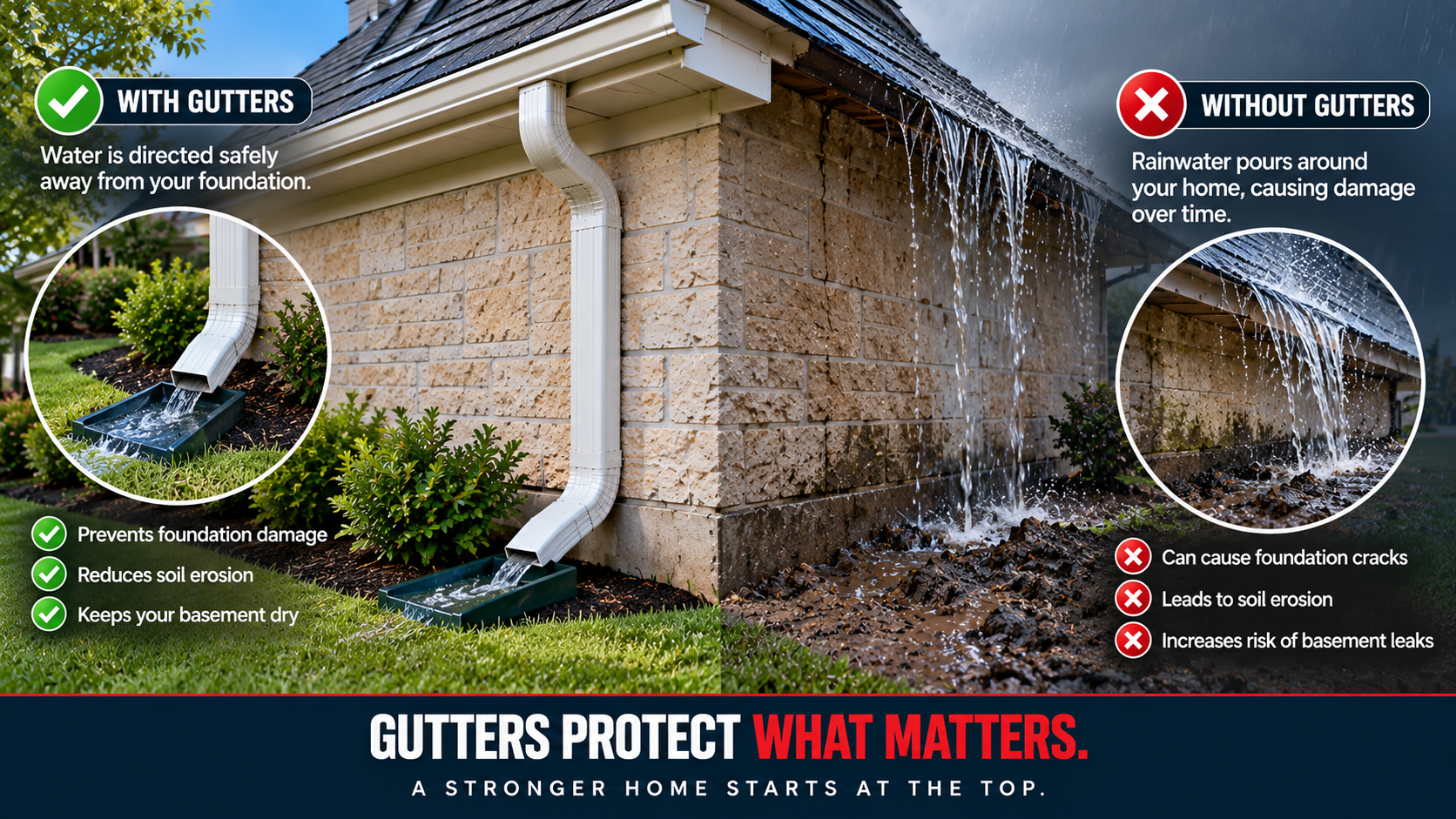
A roof can collect a surprisingly large volume of rainwater. Without an effective drainage system, that runoff falls along the roof edge and becomes concentrated around the perimeter of the house. During heavy Texas rain, repeated water discharge in the same locations can erode soil, damage landscaping and increase moisture around foundation areas.
Proper gutters give that water a controlled path. National Install provides gutter installation in Fort Worth and surrounding DFW communities. This guide explains how gutters support foundation-area water management, why downspouts matter and what homeowners should watch for during storms.
How Do Gutters Help Protect a Foundation?
The primary role of a gutter system is to intercept water as it leaves the roof. Gutters collect the runoff, carry it horizontally toward outlets and then send it through downspouts to ground level.
When the discharge point is appropriately located, the water can be moved away from the immediate foundation perimeter instead of falling directly from the eaves. This reduces the concentration of roof water beside the home.
Why Roof Runoff Can Become a Problem Around a Home
Rain does not land only on the yard. A large roof collects water across hundreds or thousands of square feet and directs it toward relatively narrow roof edges and valleys. Without gutters, that runoff can be discharged in concentrated sheets around the house.
Where water repeatedly strikes bare soil, mulch or landscaping, it can move soil particles and create channels. Where runoff collects in low areas, moisture may remain near the perimeter longer after a storm.
A gutter-and-downspout system changes the path of that water so it can be discharged at planned locations.
What Happens When a Home Has No Gutters?
Concentrated Roof Drip
Water can fall directly along the eaves, creating a narrow zone of repeated saturation beside the house.
Soil Erosion
Fast-moving roof runoff can displace mulch and soil and create visible erosion below roof edges.
Landscape Damage
Plants and beds immediately below the roofline may receive far more water than normal rainfall alone would deliver.
Exterior Splashback
Water striking the ground can splash mud and moisture onto siding, masonry, doors and other exterior surfaces.
How Gutters Reduce Soil Erosion
Erosion is fundamentally a water-flow problem. When water hits the ground with enough force or moves rapidly across exposed soil, it can carry soil particles away.
Gutters reduce direct roof-edge impact by collecting the runoff before it reaches the ground. Downspouts then concentrate the collected water at selected locations, which makes the final discharge point especially important.
A downspout that simply dumps a large volume of water onto bare soil beside the foundation can still create erosion. Splash blocks, extensions, appropriate grading or other drainage measures may be needed to manage that discharge.
Why Downspouts Are Critical to Foundation-Area Water Management
Gutters receive much of the attention, but downspouts determine where the collected water ultimately goes. If they are too small, too few, clogged or poorly located, the gutter system may back up or discharge water in undesirable places.
Downspouts should have enough capacity for the roof areas feeding them. Long gutter runs or large roof planes may require additional outlets. Their discharge should also be considered in relation to grading, walkways, landscaping and drainage paths.
This is why gutter sizing should always include the downspouts. Read What Size Gutters Do You Need for a Texas Home? for a detailed explanation.
Can Gutters Prevent Foundation Cracks?
It would be inaccurate to say that gutters can prevent every foundation crack. Foundations can move or crack for many reasons, including soil characteristics, structural conditions, construction, plumbing leaks and changes in moisture.
What gutters can do is reduce uncontrolled roof runoff and repeated water concentration beside the structure. That makes them an important preventive water-management feature, especially when combined with appropriate site grading and drainage.
If you already see structural cracking or suspect a foundation problem, consult a qualified foundation or structural professional rather than relying on gutter work as a diagnosis or repair.
Why Texas Soil and Weather Make Drainage Worth Paying Attention To
Fort Worth and North Texas can experience long dry periods followed by intense thunderstorms. These changing conditions make it especially useful to manage roof water deliberately rather than allowing it to fall wherever the roof edge directs it.
Properties also differ substantially in soil, grading, landscaping and drainage. A gutter configuration that works well on one home may need different downspout placement or discharge treatment on another.
The objective is straightforward: collect roof runoff efficiently and avoid concentrating it where it can create preventable water-management problems.
Need Better Gutter Drainage Around Your Fort Worth Home?
National Install can evaluate your roofline, existing gutters and downspout layout and recommend a gutter system based on your home’s drainage needs.
How Far Should Downspouts Discharge From the House?
There is no single distance that is correct for every property. The appropriate discharge arrangement depends on grading, soil, landscaping, nearby paving, drainage systems and local site conditions.
The practical goal is to avoid depositing roof runoff where it immediately flows back toward or pools beside the home. Extensions, splash blocks or connections to an appropriate drainage system may be useful depending on the property.
If water remains beside the foundation after storms despite functioning gutters, the site may have a grading or drainage issue that extends beyond the gutter system.
What Happens When Gutters Overflow?
An overflowing gutter can defeat much of the reason the system was installed. Water spilling over the front or back may again become concentrated near the roof edge and perimeter.
Common causes include debris, clogged outlets, inadequate downspouts, incorrect pitch, undersized gutters and heavy concentrated runoff from roof valleys.
Overflow should therefore be diagnosed rather than automatically blamed on gutter size. A clean system with poor outlet capacity can overflow just as a large gutter can overflow when blocked.
Can Clogged Gutters Affect Water Around the Foundation?
Yes. When leaves and debris prevent water from reaching an outlet, the gutter may fill and spill over. This can send water to unintended locations around the home.
Routine inspection and cleaning help maintain the drainage path. Homeowners with substantial tree debris may also consider gutter protection, while understanding that guards still require maintenance. See Do Gutter Guards Really Work? Pros, Cons and Costs.
Why Gutter Slope Matters
Gutters need enough pitch to move water toward their outlets without creating obvious low spots. If a run is incorrectly aligned, water can remain in the channel after rain or move inefficiently toward the downspout.
Sagging can create similar problems. Secure hangers and sound fascia are therefore part of drainage performance, not merely cosmetic details.
Seamless Gutters and Foundation Protection
Seamless gutters reduce intermediate joints along straight roof runs, which can mean fewer potential seam locations to monitor. But seamless construction alone does not determine how well water is managed around the foundation.
The system still needs the correct size, slope, outlets and downspouts. Learn more in Seamless Gutters vs. Regular Gutters: What’s the Difference?.
How Gutters Help Protect Landscaping
Foundation-area drainage and landscaping are closely connected because planting beds often sit directly below roof edges. Uncontrolled runoff can flatten plants, wash mulch away and carve channels through beds.
By moving roof water to planned discharge locations, gutters can reduce direct impact on these areas. Downspout discharge still needs thoughtful placement so the water is not simply transferred from one vulnerable landscape area to another.
What About Patios, Walkways and Driveways?
Roof runoff can also affect hard surfaces. Water may splash onto walls, create nuisance flow across walkways or repeatedly discharge near paving edges.
Gutters and downspouts provide more control over where that water enters the site. The final solution may involve extensions or drainage features where hardscape limits natural infiltration.
Signs Your Gutter Drainage Needs Attention
Watch for These Conditions During or After Rain
- Water spilling over gutter edges.
- Water collecting beside the foundation perimeter.
- Visible soil or mulch erosion below roof edges.
- Downspouts discharging into low areas beside the house.
- Standing water inside gutters after rain.
- Sagging or detached gutter sections.
- Muddy splash marks on exterior walls.
- Landscape washout near downspout outlets.
- Water flowing back toward the home instead of away from it.
Should You Replace Gutters That Leak at the Seams?
Not every leaking seam requires complete gutter replacement. A localized joint may sometimes be repaired depending on the material and condition of the system.
Replacement becomes more reasonable when leaks are widespread, sections are deteriorated, the system repeatedly sags or overflows, or the existing layout does not meet the home’s drainage needs.
For homeowners considering a new system, our guide to gutter installation cost in Fort Worth explains the main factors that affect project pricing.
How to Improve Gutter Performance
Start by keeping gutters and outlets clear. Observe the system during rain from a safe location and note any overflow, leaks or unusually slow drainage. Check downspout discharge locations after storms and look for erosion or pooling.
If problems persist, have the gutter size, slope, hanger condition, outlet quantity and downspout capacity evaluated. Avoid treating a single component in isolation when the underlying issue may involve the complete drainage path.
Do All Homes Need the Same Gutter Setup?
No. Roof size, pitch, valleys, architectural complexity, surrounding trees and site drainage all vary. Some roof sections receive relatively modest runoff, while others collect water from large or intersecting roof planes.
That is why a property-specific layout is preferable to simply copying the gutter size and downspout spacing from another house.
Frequently Asked Questions
Do gutters really protect a home’s foundation?
Gutters help by collecting roof runoff and directing it through downspouts instead of allowing concentrated water to fall around the home’s perimeter. They are one part of overall foundation-area water management.
Can bad gutters cause foundation problems?
Poorly functioning gutters can contribute to uncontrolled water concentration, erosion and repeated saturation near a home. Foundation problems can have many causes, so structural concerns should be evaluated by an appropriate professional.
Where should downspout water go?
It should discharge where runoff can move away appropriately rather than immediately pooling or flowing back toward the home. The exact solution depends on grading and site conditions.
Are larger gutters better for protecting the foundation?
Only when additional capacity is actually needed. Correct sizing must consider roof area, pitch, rainfall, outlets and downspouts. Bigger gutters alone do not fix poor drainage design.
Do gutter guards help protect the foundation?
They can help reduce debris entering gutters, which may support reliable drainage, but guards do not replace proper gutter sizing, downspouts, cleaning or appropriate discharge locations.
Gutter Installation and Drainage Solutions in Fort Worth
Gutters are easy to overlook because most of the system sits along the roof edge. During a storm, however, they perform an important job: collecting a large volume of roof runoff and giving that water a controlled route away from the immediate perimeter of the home.
National Install provides gutter solutions in Fort Worth and surrounding DFW service areas. If your gutters overflow, leak or discharge water where it should not go, request a free estimate for a property-specific evaluation.