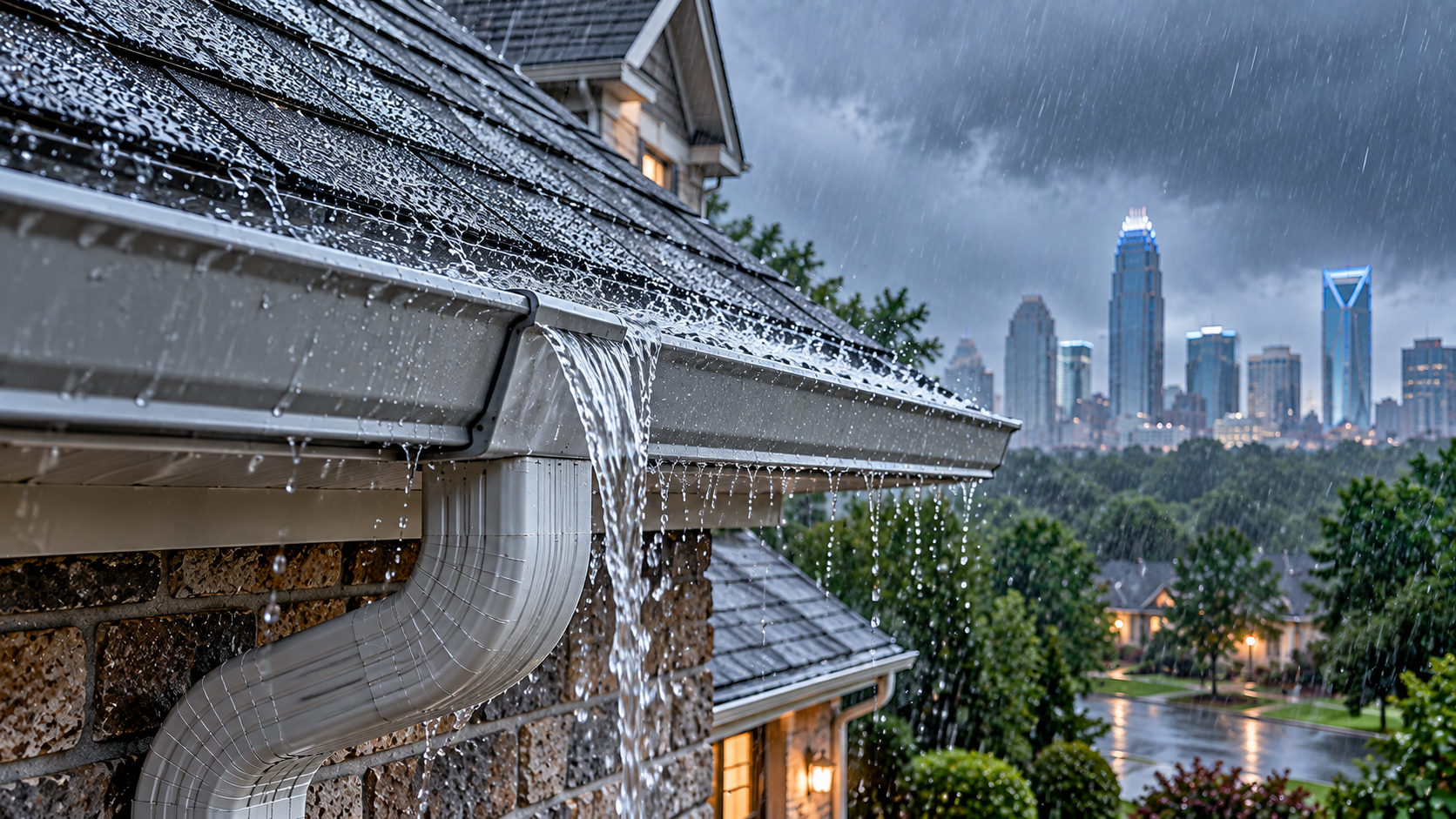
Charlotte receives substantial rainfall throughout the year, and thunderstorms can send a large volume of water from a roof in a short period. When gutters cannot collect and move that runoff efficiently, water may spill over the edge, wash through landscaping or collect where it is not wanted.
National Install provides gutter installation in Charlotte, NC and surrounding communities. In North Carolina, National Install focuses exclusively on gutter services. This guide explains what makes a gutter system effective during heavy rain and which design factors Charlotte homeowners should prioritize.
What Makes a Gutter Good for Heavy Rain?
Heavy-rain performance is a system-level issue. The gutter must capture runoff, but the outlets and downspouts must then remove that water quickly enough to prevent the channel from backing up.
Correct Gutter Capacity
The profile needs enough capacity for the roof area, pitch and runoff concentration feeding each gutter run.
Adequate Downspouts
Downspouts must be large enough and numerous enough to drain the gutter during periods of intense rainfall.
Proper Pitch
Gutter runs need appropriate slope toward outlets so water moves efficiently rather than collecting in low areas.
Strong Attachment
Secure hangers and sound attachment surfaces help the system remain aligned while carrying water.
Valley Management
Roof valleys can concentrate large amounts of runoff into short gutter sections and may require special attention.
Clear Discharge Paths
Downspout water needs somewhere appropriate to go once it reaches ground level.
Are 5-Inch or 6-Inch Gutters Better for Charlotte?
Both sizes can work when correctly matched to the home. A larger gutter has greater carrying capacity, but that does not mean every Charlotte house needs the larger option.
A simple roof with modest drainage areas may perform well with a standard residential configuration. A home with large roof planes, steep pitches, long gutter runs or valleys that concentrate runoff may justify additional capacity.
The decision should be based on how much water reaches each gutter section and how quickly the outlets and downspouts can remove it. Oversizing the gutter while leaving inadequate downspouts does not solve the complete drainage problem.
Why Downspout Capacity Matters So Much
Downspouts are sometimes treated as an accessory, but they are one of the most important components of a heavy-rain gutter system. Every gallon collected by the gutter eventually needs to pass through an outlet and downspout.
If a long gutter run has too few outlets, water can accumulate faster than it drains. This may produce overflow even when the gutter channel itself appears large enough.
Additional downspouts can shorten the distance water must travel inside the gutter and distribute drainage across more outlets. Placement should also account for where water can be discharged safely at ground level.
Seamless Gutters for Charlotte Homes
Seamless gutters are custom formed into long continuous sections for the measured roofline. They still have connections at corners and outlets, but they eliminate many intermediate joints along straight runs.
This can provide a clean appearance and reduce the number of straight-run seams that need to be monitored over time. Seamless construction does not automatically make a gutter suitable for heavy rain, however. Size, slope, outlets and downspouts remain critical.
For homeowners comparing options, the principles in our seamless gutters vs. regular gutters guide explain the practical differences between the two construction methods.
Which Gutter Material Is Best for Charlotte Rain?
| Material | Characteristics | Heavy-Rain Consideration |
|---|---|---|
| Aluminum | Lightweight, corrosion resistant and commonly available in seamless profiles | A practical residential choice when correctly sized and securely installed |
| Galvanized Steel | Strong and rigid but heavier than aluminum | Can provide durable service with appropriate installation and maintenance |
| Copper | Premium appearance and long-term material characteristics | Heavy-rain performance still depends on profile, outlets and downspouts rather than material alone |
| Vinyl | Lightweight sectional product | System design, joint condition and secure installation remain important |
Material affects durability, appearance, maintenance and cost, but it does not determine drainage capacity by itself. A properly designed aluminum system can outperform a more expensive material when the expensive system is poorly sized or configured.
How Roof Pitch Changes Rainwater Runoff
Steeper roof surfaces can deliver water toward the eaves rapidly. The total roof drainage area matters, but the speed and concentration of runoff can also affect how the gutter receives water during a storm.
Roof pitch should therefore be considered when sizing a system. Homes with steep roofs or large roof planes may require different capacity than smaller, simpler roofs.
Why Roof Valleys Can Overwhelm Gutters
A roof valley collects water from two intersecting roof planes and directs it toward a relatively narrow point at the eave. During intense rain, this can create a concentrated stream that reaches the gutter faster than runoff from surrounding roof areas.
If you see overflow mainly below a valley while the rest of the gutter performs normally, the issue may be localized runoff concentration rather than the entire gutter system.
Depending on the property, the solution may involve gutter capacity, outlet placement, downspout configuration or another appropriately designed water-management detail.
Does Your Charlotte Gutter System Overflow in Heavy Rain?
National Install can evaluate gutter size, downspouts, roofline and drainage conditions and recommend a system designed for your Charlotte-area home.
What Causes Gutters to Overflow During Heavy Rain?
Overflow does not always mean the gutters are too small. Before replacing a system, identify the actual cause.
Clogged Gutters
Leaves, seeds and organic debris reduce usable channel capacity and can prevent water from reaching outlets.
Blocked Downspouts
A clear gutter can still overflow when an outlet or downspout is obstructed.
Too Few Outlets
Long runs can collect water faster than one outlet can remove it during intense rainfall.
Incorrect Slope
Low spots or poor alignment can hold water and reduce effective drainage.
Valley Runoff
Concentrated water can overshoot or overwhelm a short section of gutter.
Insufficient Capacity
Some roof areas genuinely require a larger or differently configured gutter and downspout system.
Do Gutter Guards Help During Heavy Rain?
Gutter guards can reduce larger debris entering the gutter, which may help preserve drainage capacity. However, guards introduce another surface through which water must enter the system.
The guard design, roof pitch, debris accumulation and rainfall intensity can all affect performance. Guards should not be used as a substitute for correctly sized gutters and downspouts.
Even with guards, periodic inspection remains necessary. Leaves or fine debris can collect on top of the protection system, particularly near roof valleys or under trees.
How Should Downspouts Discharge Rainwater?
Moving water through the gutter is only part of the job. Once the downspout reaches ground level, runoff should be directed to a suitable location rather than immediately pooling beside the home.
Site grading, landscaping, hardscape and existing drainage features all affect the appropriate discharge strategy. Extensions, splash blocks or other drainage measures may be useful depending on the property.
If water repeatedly flows back toward the home after leaving the downspout, the site may require broader drainage evaluation beyond the gutter itself.
Should You Replace Gutters That Overflow?
Not automatically. First determine whether the system is clogged, damaged, sagging or poorly pitched. A maintenance or repair issue may be responsible for the overflow.
Replacement becomes more reasonable when the existing gutters are deteriorated, consistently undersized for the roof, poorly configured or affected by widespread failures.
For homeowners evaluating a new system, read How Much Does Gutter Installation Cost in Charlotte, NC? to understand the factors that influence project pricing.
How to Tell If Your Gutters Are Handling Charlotte Rain Properly
Observe the System Safely During a Storm
- Water should enter the gutter rather than consistently overshooting the front edge.
- Gutter runs should not visibly fill and spill over.
- Water should move toward outlets instead of remaining in obvious low spots.
- Downspouts should discharge steadily without backing up at the top.
- Joints and corners should not show persistent leakage.
- Gutters should remain securely attached without visible sagging.
- Discharged water should not immediately flow back toward the home.
- Landscaping below the roof edge should not show repeated washout from overflow.
Do Bigger Downspouts Help?
They can when outlet capacity is the limiting factor. Larger downspouts can move more water, but only if the gutter and outlet are configured to feed them properly.
In some cases, adding another downspout may be more useful than relying on a single larger one. The best arrangement depends on gutter-run length, roof drainage area and available discharge locations.
Are More Downspouts Better Than Bigger Gutters?
There is no universal answer because they address different parts of the system. A larger gutter increases channel capacity, while additional downspouts increase drainage opportunities.
A well-designed heavy-rain system balances both. Increasing only one component can leave another as the bottleneck.
What About Long Gutter Runs?
Long runs receive water from a large section of roof and require that water to travel farther before reaching an outlet. During intense rainfall, this can increase the importance of slope and outlet placement.
Depending on the roof and architecture, splitting drainage between multiple downspouts may improve performance. Long runs should be evaluated as part of the complete roof drainage area rather than by length alone.
Maintenance Still Matters in a High-Capacity System
Even correctly sized gutters lose capacity when filled with debris. Charlotte’s trees can deposit leaves, seeds and other organic material that collect in gutters and outlets.
Cleaning frequency varies by property. Homes beneath mature trees generally need more attention than homes with little nearby vegetation. Our next guide explains how often Charlotte homeowners should clean their gutters.
What Should You Ask a Gutter Installer?
Ask why a particular gutter size is being recommended, how many downspouts are included and how roof valleys or large drainage areas are being handled. The installer should also explain material, attachment method, removal scope, discharge considerations and warranty terms.
If one proposal differs substantially from another, compare the actual specifications rather than only the total price. Different gutter dimensions or downspout quantities may explain the difference.
Frequently Asked Questions
What are the best gutters for heavy rain in Charlotte, NC?
The best system is properly sized for the roof and includes adequate outlets and downspouts. Seamless aluminum is a common residential choice, but design and capacity matter more than material alone.
Are 6-inch gutters better for heavy rain?
They provide greater channel capacity than smaller profiles, but not every home needs them. Roof drainage area, pitch, valleys and downspout capacity should determine sizing.
Why do my gutters overflow only during very heavy rain?
Possible causes include inadequate capacity, too few downspouts, concentrated valley runoff, poor pitch or partial blockage. Observing where overflow occurs can help identify the cause.
Will gutter guards stop overflow?
Not necessarily. Guards can reduce debris entering the gutter, but they do not increase an undersized system’s fundamental capacity and may require surface maintenance.
Does National Install provide roofing services in Charlotte?
No. National Install’s North Carolina service offering is focused on gutter installation and gutter-related services only.
Gutter Installation for Heavy Rain in Charlotte, NC
A gutter system that performs well in heavy rain depends on more than choosing the largest product available. Capacity, roof geometry, slope, outlets, downspouts, secure installation and ground-level discharge all work together.
National Install provides gutter services in Charlotte and nearby North Carolina communities. Visit our Charlotte gutter installation page, review our service areas or request a free estimate for your home.