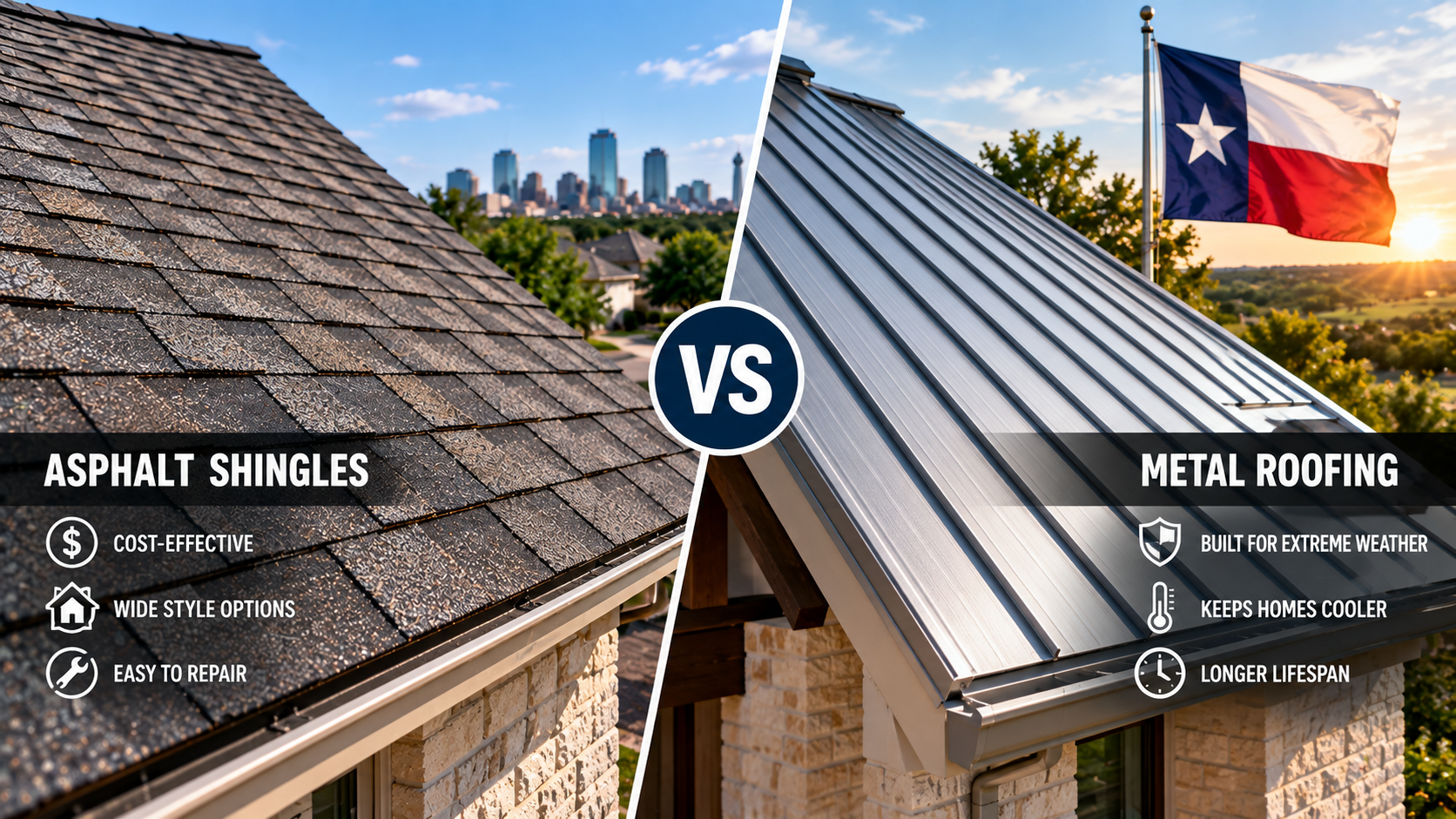
For homeowners in Fort Worth and across North Texas, choosing between asphalt shingles and metal roofing is more than a style decision. Texas roofs must contend with intense summer sun, hailstorms, high winds and rapid weather changes, so the material needs to fit both the home and the local environment.
National Install provides roofing services in Fort Worth and surrounding DFW communities. Below, we compare asphalt shingles vs. metal roofing across the factors homeowners most often ask about: cost, durability, heat, hail, wind, maintenance, appearance and long-term value.
Asphalt Shingles vs. Metal Roofing: At a Glance
| Factor | Asphalt Shingles | Metal Roofing |
|---|---|---|
| Initial Cost | Typically lower | Typically higher |
| Installation | Common residential system with broad installer familiarity | Requires system-specific metal roofing expertise |
| Service Potential | Good, varies significantly by product and conditions | Often longer with quality materials and installation |
| Texas Heat | Many colors and reflective product options available | Reflective finishes can perform very well in hot climates |
| Hail | Impact-resistant shingle options available | Can resist functional damage well, though cosmetic denting may occur |
| Wind | Strong performance possible with rated products and correct installation | Properly engineered systems can provide excellent wind resistance |
| Repairs | Individual shingles can often be repaired or replaced | Repair complexity varies by panel system |
| Appearance | Wide range of traditional colors and profiles | Clean contemporary or traditional architectural appearance |
What Are Architectural Asphalt Shingles?
Architectural asphalt shingles are laminated roofing products designed to create more dimension and visual depth than basic three-tab shingles. They are widely used on residential roofs because they offer a practical balance of price, appearance and performance.
Texas homeowners can choose from many architectural shingle lines with different warranties, wind ratings and impact classifications. Premium and impact-resistant shingles can be especially relevant in hail-prone areas.
Advantages of Asphalt Shingles
Lower Initial Investment
Asphalt shingles generally cost less to install than a comparable quality metal roofing system, making them accessible for a wider range of replacement budgets.
Broad Style Selection
Homeowners can choose from many colors, textures and dimensional profiles that work well with brick, stone, siding and other common Texas home exteriors.
Repairability
Localized shingle damage can often be addressed without replacing an entire roof plane, depending on roof age, product availability and the extent of damage.
Impact-Resistant Options
Some shingles are specifically designed and tested for improved impact resistance, an important consideration in North Texas hail country.
What Is Metal Roofing?
Residential metal roofing includes several systems, with standing-seam panels among the most recognizable. These roofs use metal panels with raised seams and concealed or system-specific fastening methods. Other residential metal products can mimic shingles, tile or shake.
Metal is often chosen for longevity, architectural appearance and weather performance. However, the material is only part of the system. Panel profile, metal thickness, finish, fasteners or clips, flashing and edge details all affect performance.
Advantages of Metal Roofing
Long Service Potential
A quality metal roofing system can provide a long service life when correctly designed, installed and maintained.
Strong Wind Performance
Properly engineered metal systems can perform very well in high winds, provided the complete assembly follows applicable manufacturer requirements.
Reflective Finish Options
Many metal roofs use coatings designed to reflect a portion of solar energy, which can be advantageous in the Texas heat.
Distinctive Appearance
Standing-seam metal creates crisp lines and can complement contemporary, farmhouse and many traditional home designs.
Which Costs More: Asphalt Shingles or Metal Roofing?
Metal roofing generally requires a larger upfront investment than asphalt shingles. Material costs, specialized labor, flashing details and roof complexity all contribute to the difference.
Asphalt shingles are typically the better fit when initial project cost is the primary concern. Metal may make sense for homeowners who plan to stay in the property long term and place a higher value on service potential, appearance and certain performance characteristics.
Actual pricing depends on roof size, pitch, tear-off requirements, decking condition, material selection and details such as valleys, dormers and penetrations. For the broader cost factors involved in reroofing, see how much a new roof costs in Fort Worth.
Comparing Roofing Options for Your Fort Worth Home?
National Install can evaluate your roof and help you compare material options based on your home, budget and North Texas weather exposure.
Which Is Better for Texas Heat?
Both materials can be used successfully in hot climates. Metal roofing has an advantage in the availability of highly reflective coated finishes, but modern asphalt products also include lighter colors and reflective options.
Roof surface alone does not determine indoor temperature. Attic ventilation, insulation, radiant heat transfer, roof color and the entire assembly influence how much heat reaches the living space.
If heat performance is a major priority, compare the specifications of the exact shingle or metal finish being proposed instead of assuming all products within a material category perform the same way.
Which Is Better for Texas Hail?
Hail performance is more nuanced. Impact-resistant asphalt shingles can provide improved resistance compared with conventional shingles. Metal roofing can also resist functional damage well, but certain hail events may leave visible dents depending on metal thickness, panel design, substrate and hail severity.
Neither material should be described as hail-proof. Large, hard or wind-driven hail can damage many roofing products. If your roof has already experienced a storm, review what hail damage looks like and the signs a roof may need repair after a Texas storm.
Which Is Better for High Winds?
Both quality asphalt and metal systems can be rated for significant wind exposure. The important distinction is that wind resistance belongs to the complete roof system, not simply the surface material.
With asphalt shingles, starter strips, fastening locations, adhesive seals and edge details are important. With metal roofing, panel attachment, clips or fasteners, seams and perimeter conditions matter. Roof geometry and deck condition also influence performance.
In either case, installation according to manufacturer specifications is critical.
Which Roof Lasts Longer in Texas?
Metal roofing generally has greater service-life potential than asphalt shingles, but actual roof life varies. Texas sun, hail, maintenance, ventilation, installation quality and storm history all affect longevity.
A high-quality shingle roof can provide many years of reliable service, while a properly installed metal roof may remain serviceable substantially longer. For a detailed discussion of lifespan variables, read how long a roof lasts in Texas.
Maintenance and Repairs
Asphalt Shingle Maintenance
Shingle roofs should be periodically checked for missing, lifted or damaged shingles, deteriorated flashing, sealant issues and debris accumulation. Individual shingles can often be replaced when damage is localized and compatible materials remain available.
Metal Roof Maintenance
Metal roofs should be inspected for flashing conditions, sealants where used, penetrations, panel damage and system-specific fasteners or components. Repair methods depend on the type of metal roof and should preserve the system’s water-shedding design.
If you are dealing with an existing problem rather than choosing a new material, National Install provides roof repair in Fort Worth.
Noise: Is a Metal Roof Loud During Rain?
A metal roof is not necessarily excessively loud inside a finished home. Residential metal roofing is typically installed over a roof assembly that includes decking, underlayment, attic space and insulation. Those layers can significantly reduce transmitted sound.
Noise characteristics vary by assembly. A metal roof on an open agricultural structure is very different from a metal roof installed over a conventional insulated residence.
Can Metal Roofing Make a Home Hotter?
Not simply because it is metal. Many metal roofing finishes reflect solar radiation effectively. The roof color, coating, ventilation and insulation all influence thermal performance.
Similarly, asphalt shingles come in a range of colors and technologies. The most useful comparison is between the actual products and complete roof assemblies under consideration.
Which Has Better Curb Appeal?
This is largely personal. Architectural shingles provide a familiar dimensional appearance that works with nearly any residential style. Metal roofing offers sharper lines and a more distinctive profile.
Homeowners should consider neighborhood architecture, exterior materials and how long they expect to own the property. Color selection is also important because a roof is one of the largest visible surfaces on a home.
Which Is Easier to Repair After a Storm?
Asphalt shingles often have an advantage in localized repair because individual shingles or a defined section can sometimes be replaced. However, matching an older discontinued shingle can be challenging.
Metal panel repair can be more involved depending on the system and where the damaged panel is located. A professional should evaluate whether repair can be performed without compromising adjacent seams, flashing or finishes.
Choose Asphalt Shingles If…
- You want a lower initial project cost.
- You prefer a traditional residential roof appearance.
- You want a broad selection of colors and profiles.
- You value straightforward localized repair options.
- An impact-resistant architectural shingle fits your hail-performance goals.
Choose Metal Roofing If…
- You are comfortable with a higher upfront investment.
- Long service potential is a major priority.
- You prefer the architectural appearance of metal.
- You want access to reflective finish options.
- A properly engineered metal system fits your roof and performance goals.
Asphalt vs. Metal: What About Homeowners Insurance?
Insurance treatment varies by carrier, policy, roof age, material and location. Some insurers may consider impact-resistant roofing characteristics when underwriting or pricing a policy, but homeowners should confirm details directly with their insurer before assuming a material will reduce premiums or change coverage.
If you are researching storm-related coverage, see whether homeowners insurance may cover roof damage in Texas.
Frequently Asked Questions
Is a metal roof better than shingles in Texas?
Metal can offer longer service potential and excellent wind and heat-performance options, but shingles usually cost less initially and provide strong residential performance. The best choice depends on the homeowner’s priorities.
Are asphalt shingles good for Texas weather?
Yes. Quality architectural shingles are widely used in Texas, and impact-resistant and higher-wind-rated products are available. Correct installation and product selection are important.
Can hail dent a metal roof?
Yes. Depending on hail severity and the metal system, hail can create cosmetic denting and, in more severe cases, functional damage. Metal roofing should not be considered hail-proof.
Are metal roofs more energy efficient?
Metal roofs can use reflective finishes that reduce solar heat absorption, but overall home energy performance also depends on roof color, insulation, ventilation and the complete building envelope.
Which roof is more affordable to replace?
Asphalt shingles generally have a lower initial replacement cost than metal roofing. The final price depends on roof size, complexity, tear-off, decking and the specific products selected.
Which Roof Should You Choose for Your Fort Worth Home?
There is no universal winner in the asphalt shingles vs. metal roofing comparison. Asphalt shingles are an excellent choice for homeowners seeking value, flexibility and a traditional appearance. Metal roofing can be compelling for homeowners willing to invest more upfront for longer service potential, distinctive styling and strong system performance.
Before deciding, compare the actual products, warranties, installation specifications and total project scope. Our broader guide to the best roofing materials for Texas heat, hail and high winds can help put both choices in context.
National Install serves Fort Worth and surrounding DFW service areas. If you are planning a new roof, request a free estimate to discuss the roofing options that fit your home.